Cookies

Fall 2025

Interactive Web Art, P5.js

View Live Project

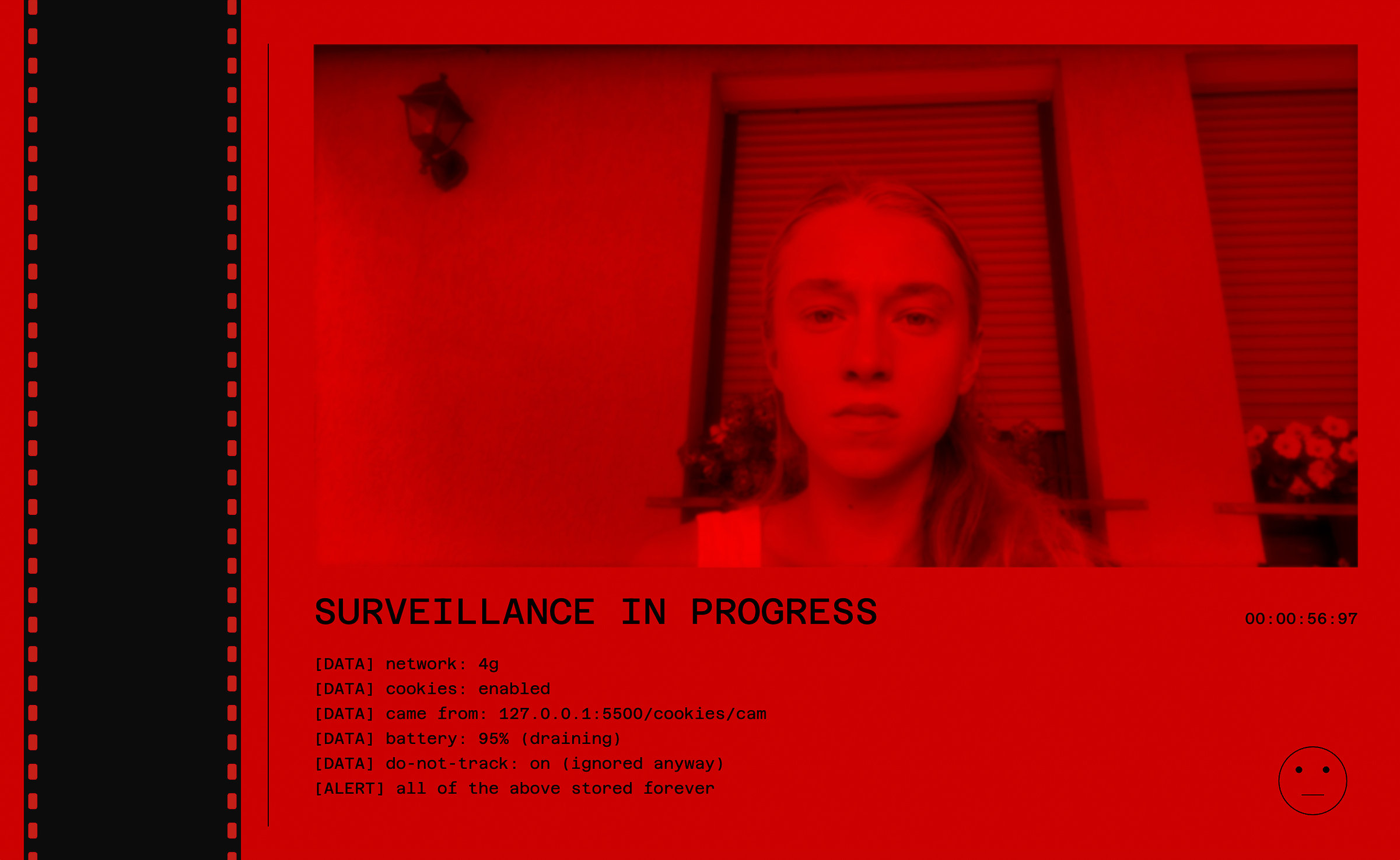
Cookies project interface Cookie consent modal Escaping button interaction Surveillance camera view Screenshot capture feature Interactive face tracking

Concept

Cookies is a critical web art piece that exposes the manipulative design patterns in cookie consent dialogs and online surveillance. The project presents a seemingly familiar cookie consent modal where the Manage Settings button actively escapes the cursor using physics-based mouse avoidance, making it nearly impossible to click. This deliberately frustrating interaction mirrors how websites make it difficult to decline data collection. Once accepted, users are confronted with a surveillance interface featuring their own webcam feed processed in red duotone, fake surveillance messages, automatic screenshot capture, and an unsettling face that tracks mouse movement.

Technical Implementation

Built with P5.js, the project implements sophisticated interaction mechanics including exponential force curves for realistic button escape behavior, real time webcam processing with duotone filtering, automatic screenshot capture and display, and mouse tracking for the interactive surveillance face. The button escape mechanism uses distance calculations and velocity dampening to create natural panic responses. The surveillance page captures webcam screenshots on click, displays them as grayscale thumbnails with timestamps, and processes the main camera feed with a custom duotone algorithm that maps luminance values between shadow and highlight colors.

Critical Commentary

The work functions as both satire and critique of contemporary web practices. By making the dark pattern explicitly visible through the escaping button, it reveals the psychological manipulation typically hidden in consent interfaces. The transition from deceptive consent to explicit surveillance creates an uncomfortable moment of recognition about data collection practices. The fake surveillance messages and automatic screenshot capture emphasize how accepting cookies grants invasive access to personal data and behavior. The piece forces users to experience the reality behind casual consent clicks.